
If you’ve tried building a multi-agent system, you’ve hit the same wall: getting agents to share context without writing custom glue code for every integration.
You start with a simple workflow. Maybe an agent that pulls data from your CRM, runs analysis, and updates a spreadsheet. Then you add a second agent to handle notifications. A third to validate the data. Suddenly you’re maintaining a mess of custom adapters, each one mapping outputs to inputs in slightly different ways.
This is the integration tax of agentic AI, and it only gets worse as you scale.
The industry’s response has been the emergence of a new architectural layer: agent communication protocols. These protocols provide standardized ways for AI systems to connect with data sources and for agents to communicate with each other, replacing fragmented integrations with universal standards.
Two protocols now dominate this landscape: Model Context Protocol (MCP) from Anthropic, which standardizes how AI assistants connect to systems where data lives, and Agent2Agent (A2A) from Google, which enables AI agents to communicate with each other and coordinate actions across different platforms.
Understanding these protocols is no longer optional. Whether you’re building multi-agent systems, secure enterprise workflows, or GenAI-enhanced developer tools, these standards will shape your architecture.
The Core Challenge
Even the most sophisticated models are constrained by their isolation from data, trapped behind information silos and legacy systems. Before MCP, developers had to build custom connectors for each data source or tool, resulting in an “N×M” data integration problem.
The same fragmentation exists for agent-to-agent communication. AI agents built on diverse frameworks by different companies running on separate servers need a way to communicate and collaborate effectively as agents, not just as tools.
What Is MCP?
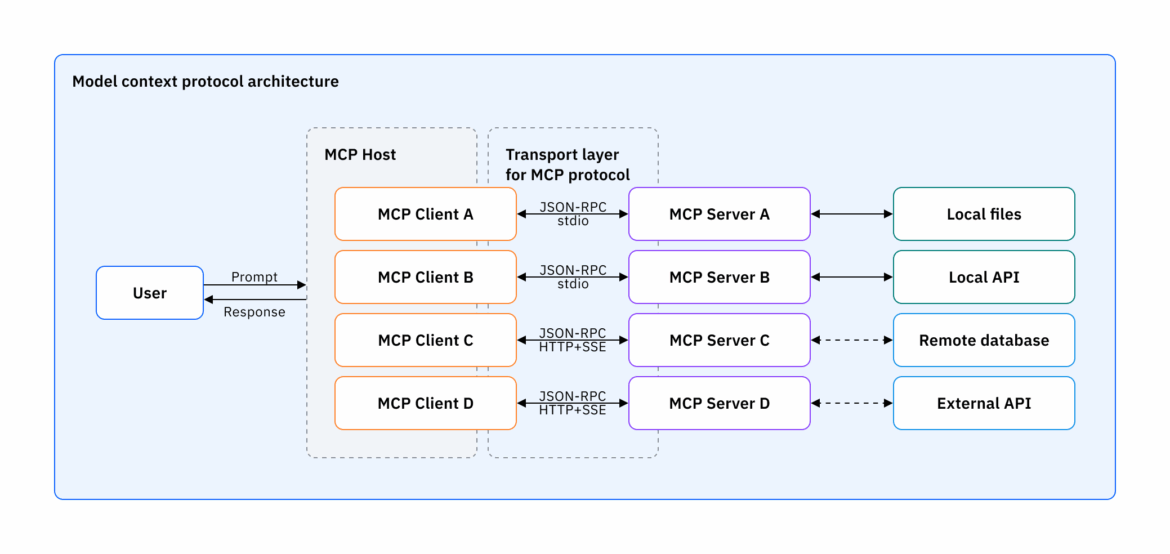
Photo credit: IBM
Model Context Protocol (MCP) is an open-source standard for connecting AI applications to external systems, allowing applications like Claude or ChatGPT to connect to data sources, tools, and workflows.
The protocol enables agents to access:
- Real-time business data from databases and APIs
- Tool outputs and function call chains
- Intermediate reasoning steps
- Document repositories and file systems
MCP provides a universal, open standard that replaces fragmented integrations with a single protocol. Think of it as solving the “last mile” problem for AI: giving models the ability to actually interact with the systems and data they need.
How MCP works: The architecture has two main components: MCP servers that expose data and tools, and MCP clients (AI applications) that connect to these servers. The protocol uses JSON-RPC 2.0 as its messaging format and supports stdio and HTTP with Server-Sent Events as transport mechanisms.
Adoption trajectory: Since launching in November 2024, adoption has been rapid with the community building thousands of MCP servers and SDKs available for all major programming languages. OpenAI officially adopted MCP in March 2025, integrating the standard across its products including the ChatGPT desktop app. Pre-built MCP servers now exist for popular enterprise systems like Google Drive, Slack, GitHub, Git, Postgres, and Puppeteer.
The efficiency breakthrough: When agents use hundreds or thousands of tools, tool definitions and results can consume excessive tokens. Anthropic’s code execution approach with MCP can reduce token usage by up to 98.7% by loading tools on demand rather than all at once.
Read my blog on What is MCP? for a deeper dive.
What Is A2A?
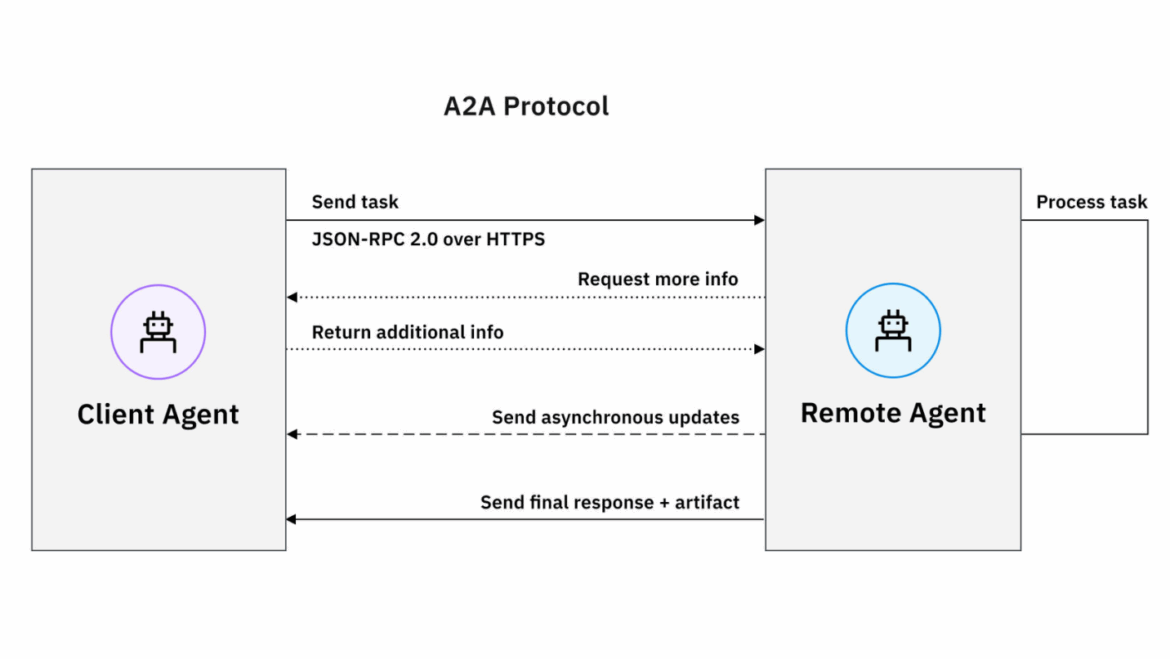
Photo credit: IBM
Agent2Agent (A2A) is an open protocol launched by Google with support from more than 50 technology partners including Atlassian, Box, Cohere, Salesforce, SAP, ServiceNow, and others. It is now housed by the Linux Foundation as the open-source Agent2Agent project.
Where MCP focuses on connecting agents to tools and data, A2A addresses agent-to-agent collaboration.
Core capabilities: A2A enables capability discovery through Agent Cards in JSON format, task management with defined lifecycles for both quick and long-running tasks, collaboration through standardized messaging, and user experience negotiation.
How agents discover each other: Agents advertise their capabilities using Agent Cards that allow client agents to identify the best agent for a task and initiate communication through the A2A protocol. This is similar to how services expose OpenAPI specifications, but designed specifically for autonomous agents.
Task-oriented architecture: Communication between agents is oriented toward task completion, with tasks having defined lifecycles that can be completed immediately or managed over extended periods as agents stay in sync.
Enterprise security: A2A is designed to support enterprise-grade authentication and authorization, with parity to OpenAPI’s authentication schemes. The protocol’s focus on secure, long-running tasks makes it viable for regulated environments.
What About IBM’s ACP?
IBM initially developed the Agent Communication Protocol (ACP) through its BeeAI platform and contributed it to the Linux Foundation. However, in August 2025, ACP officially merged with A2A under the Linux Foundation umbrella, with IBM winding down active development of ACP to contribute its technology and expertise directly to A2A.
This consolidation is significant. Rather than fragmenting the ecosystem with competing standards, IBM’s decision to merge ACP into A2A creates a single, more powerful standard for how AI agents communicate and collaborate.
MCP + A2A
These protocols solve different problems at different layers of the stack. MCP connects each agent to its tools, while A2A connects agents to each other.
In a comprehensive multi-agent system:
- MCP handles the vertical integration: Connecting agents to databases, APIs, file systems, and external tools they need to accomplish work
- A2A handles the horizontal coordination: Enabling agents to discover each other, delegate tasks, share results, and coordinate complex workflows
MCP uses JSON-RPC as its communication protocol, while A2A adopts a RESTful architecture over HTTP, supporting both synchronous and asynchronous agent interactions. This architectural distinction reflects their different roles: MCP optimizes for tool invocation, A2A for peer coordination.
Real-world example: In a multi-agent investment system, MCP connects each agent to its tools like APIs to fetch market data and run simulations, while A2A connects agents to each other to share results, compare data, and decide, before outputting a recommendation.
Where the Ecosystem Stands Today
MCP has become one of the dominant protocols, with widespread adoption, while A2A is gaining momentum particularly for collaborative multi-agent workflows. Research firm Everest Group notes that enterprises should align protocol use with their architecture: centralized approaches favor MCP, while collaborative scenarios benefit from A2A.
The trajectory suggests layered coexistence rather than winner-take-all. In practice, development tools will hide much of the complexity, allowing teams to focus on workflow design rather than the underlying wire protocols.
Why This Matters for Builders
If you’re building anything beyond a simple chatbot, these protocols will directly impact:
Development velocity: Instead of maintaining separate connectors for each data source, developers can now build against a standard protocol. This compounds: every new MCP server or A2A-compatible agent expands what your system can do without custom integration work.
System capabilities: These protocols enable dynamic discovery, secure communication, and decentralized collaboration across heterogeneous agent systems. Your agents can now coordinate in ways that would have required months of custom development.
Enterprise viability: A2A’s enterprise-grade authentication, long-running task support, and security model combined with MCP’s standardized tool access creates a foundation that compliance and security teams can approve.
Making the Choice
Start with MCP when:
- You need agents to access existing business tools and external data
- Your architecture is relatively centralized
- You’re working with OSS frameworks like LangChain, LlamaIndex, or DSPy
- You want the widest ecosystem of pre-built integrations
Add A2A when:
- You need multiple specialized agents to collaborate
- Tasks require coordination across organizational boundaries
- Your workflow involves agent-to-agent negotiation and delegation
- You’re building for enterprise scale with complex multi-agent orchestration
The real opportunity: Most production systems will use both. MCP gets your agents connected to the tools and data they need. A2A enables those agents to work together as a coordinated system. Together, they provide the infrastructure layer for scalable, intelligent AI systems.
This is the new foundation for agentic AI. The companies that understand and adopt these protocols early will move faster, build more capable systems, and avoid the integration debt that slows everyone else down.
