Updated August 2026: AutoGen became the Microsoft Agent Framework
You know that moment when your AI assistant gives you a generic, barely-useful answer and you’re left thinking:
“You had one job”?
Now imagine that assistant had a team. Not just one model trying to do it all, but a crew of specialized agents working together, tapping into external tools, retrieving fresh context, and collaborating to actually solve the task at hand.
That’s what RAGENTIC is all about. It stands for Retrieval-Augmented Generation Enhanced by a Multi-Agent Architecture, and it’s an agentic RAG pattern for how we structure AI systems. Instead of relying on one large language model to carry the load, RAGENTIC splits the work across multiple focused agents, each equipped with the ability to retrieve relevant information and act autonomously.
Here’s what makes it so compelling:
- Agentic AI is the future: RAGENTIC shows that teams of AI agents can outperform single-model systems.
- RAG isn’t just retrieval, it’s retrieval plus orchestration: When combined with agents, retrieval becomes contextual, dynamic, and actionable.
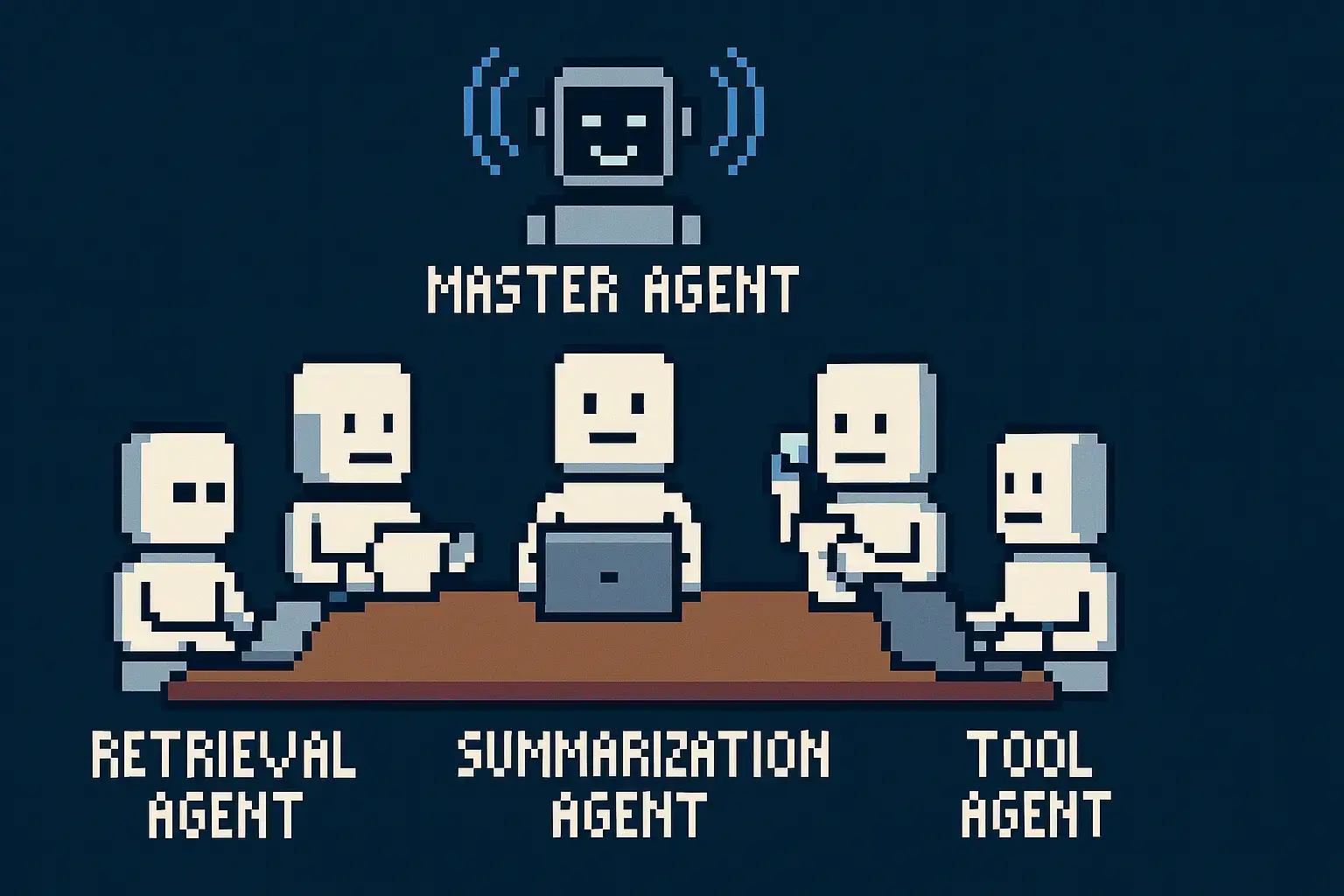
- Multi-agent collaboration drives real problem-solving: Specialized agents handle subtasks and report to a master agent, making workflows more efficient.
- It integrates with real tools: Agents can query APIs, use search engines, interact with docs, and execute tasks. MCP standardized how agents connect to tools.
- Microsoft’s Agent Framework powers it all: the successor to AutoGen makes building RAGENTIC-style systems approachable.
Agentic AI, But Smarter
Traditional LLMs are incredible, but asking one model to do everything, from understanding the question to retrieving data to solving the problem, has limits. The RAGENTIC approach introduces specialized agents that divide and conquer.
There’s a master agent coordinating the process, and a set of expert agents responsible for specific capabilities: retrieval, synthesis, summarization, calculation, tool usage, and more. It’s like assembling an AI team where each member plays to their strengths.
This structure not only makes outputs more accurate, it also enables more complex task execution. Think customer support workflows, multi-step business analysis, or real-time data evaluation.
RAG: More Than Just Context Windows
RAG (Retrieval-Augmented Generation) has already changed the game by helping LLMs ground their answers in real, up-to-date information. But in RAGENTIC, RAG goes further because the system isn’t just injecting knowledge, it’s distributing knowledge to the right agents.
Instead of relying on a single retrieval plugin or doc search, each agent can invoke its own tools.
For example:
- A data agent might fetch financial reports from an API.
- A legal agent might scan internal contract databases.
- A search agent might hit the web for the latest market trends.
All that retrieved context is then assembled, cross-checked, and synthesized into a final response. It’s less like stuffing data into a prompt, and more like running a full-on research sprint.
The Agent Framework Makes It Real
The glue that holds this together is the Microsoft Agent Framework, the open-source successor to AutoGen. Microsoft shipped version 1.0 in April 2026, built by the same teams, merging AutoGen’s multi-agent orchestration with Semantic Kernel’s enterprise features into one production-ready SDK for Python and .NET.
The Agent Framework lets you:
- Define agent roles and behavior
- Orchestrate multi-agent workflows with graph-based execution paths
- Add state management, memory, and telemetry
- Connect to tools and RAG pipelines through built-in MCP support
Still on AutoGen? It gets bug fixes and security patches, but new projects belong on the Agent Framework. Microsoft published migration guides for exactly this move.
The Agent Framework is what makes RAGENTIC possible in practice. Not just as a concept, but as a production-ready strategy.
Why All of This Matters
Multi-agent architectures like RAGENTIC aren’t just clever. They’re necessary. As businesses look to embed AI deeper into real-world workflows, a single generalist model won’t cut it.
We need systems that are modular, orchestrated, and smart enough to use tools. RAGENTIC delivers that. It’s how we move from one-off responses to automated task execution. From chatbots to copilots.
And the best part? You can start building it today.
Ready to Build Smarter AI Systems?
If you’re working on GenAI, LLM orchestration, or multi-agent frameworks, or want to start, let’s talk.
I’ll help you architect the pieces, pick the right tools, and get from prototype to production.
