
Updated August 2026
Every week it feels like something new is “decentralized.” But Decentralized Physical Infrastructure Networks (aka DePIN) are something entirely different. Unlike most crypto projects that stay in the digital world, DePIN extends blockchain principles into the physical layer: think connectivity, storage, and energy grids. I’ve been fascinated watching Helium, Filecoin, and others pioneer this space, and if you’re curious about where DePIN fits into the future of infrastructure, here’s what you need to know.
Key Takeaways
✅ DePIN brings decentralization into the real world. Instead of only decentralizing data or finance, DePIN incentivizes people to deploy hardware, like hotspots or storage nodes, that build critical physical networks.
✅ Token incentives fuel growth. By rewarding participants with tokens, DePIN networks scale without a central entity buying and maintaining all the infrastructure.
✅ It’s more than crypto hype. DePIN has real, working use cases today, like Helium’s decentralized wireless network or Filecoin’s distributed storage.
✅ AI is DePIN’s killer app. Nearly half of the DePIN market is now AI related, with decentralized GPU networks easing the compute crunch for startups priced out of big cloud.
✅ DePIN has the potential to disrupt legacy industries. Connectivity, cloud, and even energy infrastructure could shift from giant corporations to community-powered networks.
So, What Exactly Is DePIN?
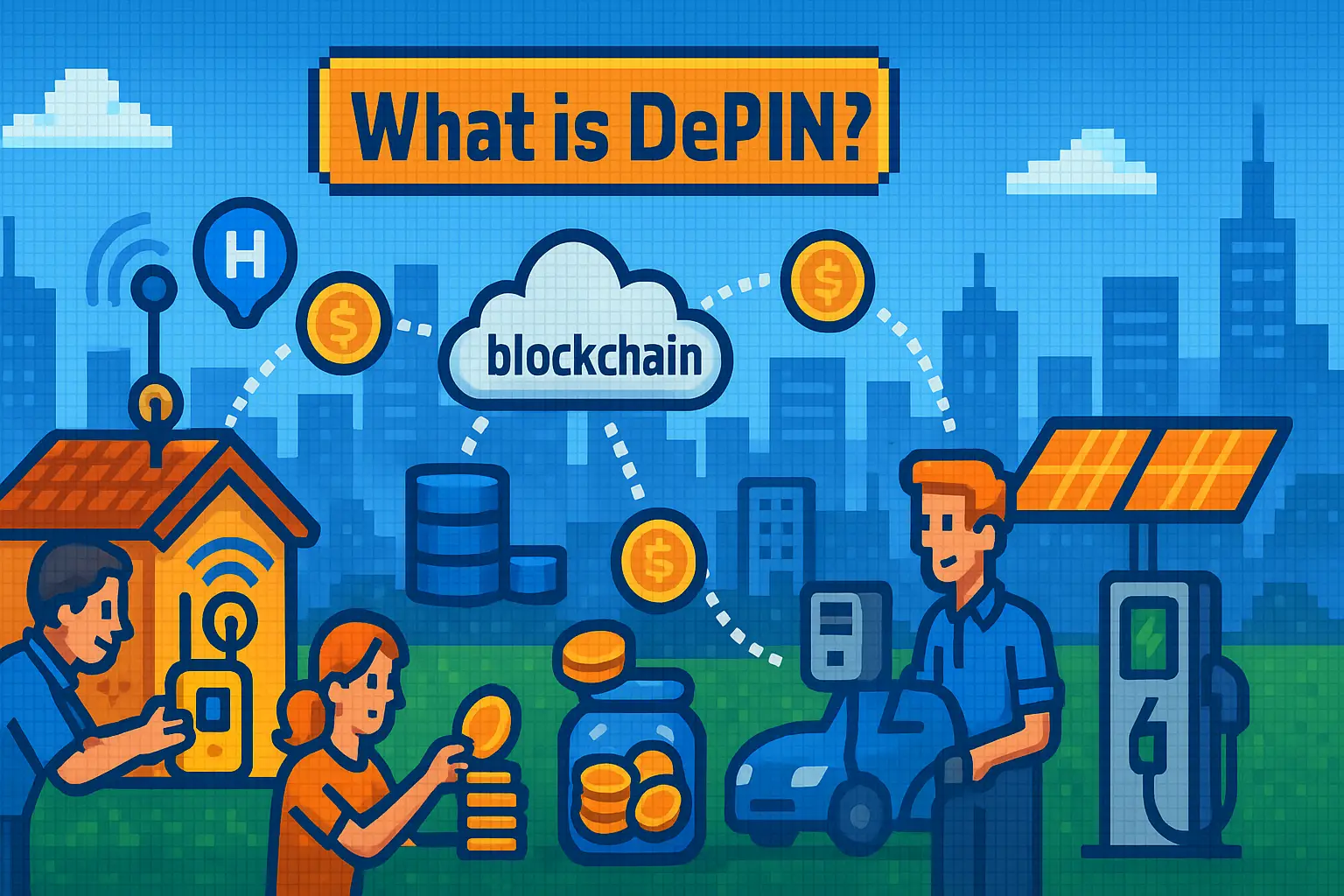
DePIN stands for Decentralized Physical Infrastructure Networks, a new category of blockchain projects that use crypto token incentives to coordinate, build, and operate physical networks. Instead of a telecom giant rolling out every cell tower or a cloud provider buying every server, DePIN lets anyone contribute hardware to the network, and earn tokens in return.
A DePIN project uses smart contracts and decentralized ledgers to track contributions and distribute rewards, ensuring trust and transparency without a central authority.
Why Does DePIN Matter?
For decades, physical infrastructure has been dominated by corporations and governments. But DePIN flips the model on its head: it lets communities build, own, and benefit directly from the infrastructure they use.
This approach has three big advantages:
- Faster scalability: Anyone can deploy hardware, speeding up network expansion.
- Lower costs: Community ownership reduces the need for huge capital expenditures.
- Resilience and decentralization: Distributed infrastructure is harder to censor, control, or take down.
Examples of DePIN in the Wild
Helium: Decentralized Wireless
Helium lets individuals deploy wireless hotspots and earn HNT tokens when devices use their network. The result? Thousands of independent people creating a wireless network spanning cities and rural areas alike, no telecom monopoly required. The big 2026 twist: Helium Mobile was acquired by Noble Mobile, freeing the Helium team to double down on the network itself as a connectivity platform any carrier can build on. I break down the full story in my Helium and HNT guide.
Filecoin: Decentralized Storage
Filecoin pays storage providers around the world to offer disk space, creating a decentralized cloud storage alternative that competes with AWS or Google Cloud. In late 2025, Filecoin launched Onchain Cloud, evolving from archival storage into a programmable cloud platform built for AI agents and enterprise workloads.
GPU Compute: DePIN’s Killer App
AI has an insatiable appetite for GPUs, and big cloud cannot keep up. Networks like Render, Akash, io.net, and Aethir aggregate idle GPUs from data centers, gaming rigs, and former mining farms into marketplaces developers can buy from today. Even Nvidia took notice and partnered with Akash. When the chip giant validates your category, you are past the hype phase.
Energy and Beyond
Projects like Glow are applying DePIN incentives to solar farms, while others target EV charging and grid balancing. The playbook that built wireless and storage networks is coming for the power grid next.
How DePIN Changes Incentives
Traditional infrastructure rewards a small group of corporate stakeholders. DePIN redistributes that value to the people actually building and operating the network. By aligning incentives with token economics, DePIN can coordinate large-scale, distributed networks with minimal overhead and bureaucracy.
The 2026 twist? The sector is shifting from mining to serving. Token rewards alone no longer cut it. The networks winning now are the ones with real paying customers.
Final Thoughts: DePIN and the Future of Infrastructure
We’ve seen decentralization revolutionize finance, content, and data. DePIN could do the same for the physical systems we rely on every day, making connectivity, storage, and energy more resilient, affordable, and locally owned.
If you’re an investor, builder, or just someone curious about the future of infrastructure, DePIN deserves your attention. We’re only at the beginning of what’s possible.
Want to dive deeper or explore how DePIN might impact your industry? Drop me a message or join the conversation on LinkedIn. Let’s build the decentralized future together.
